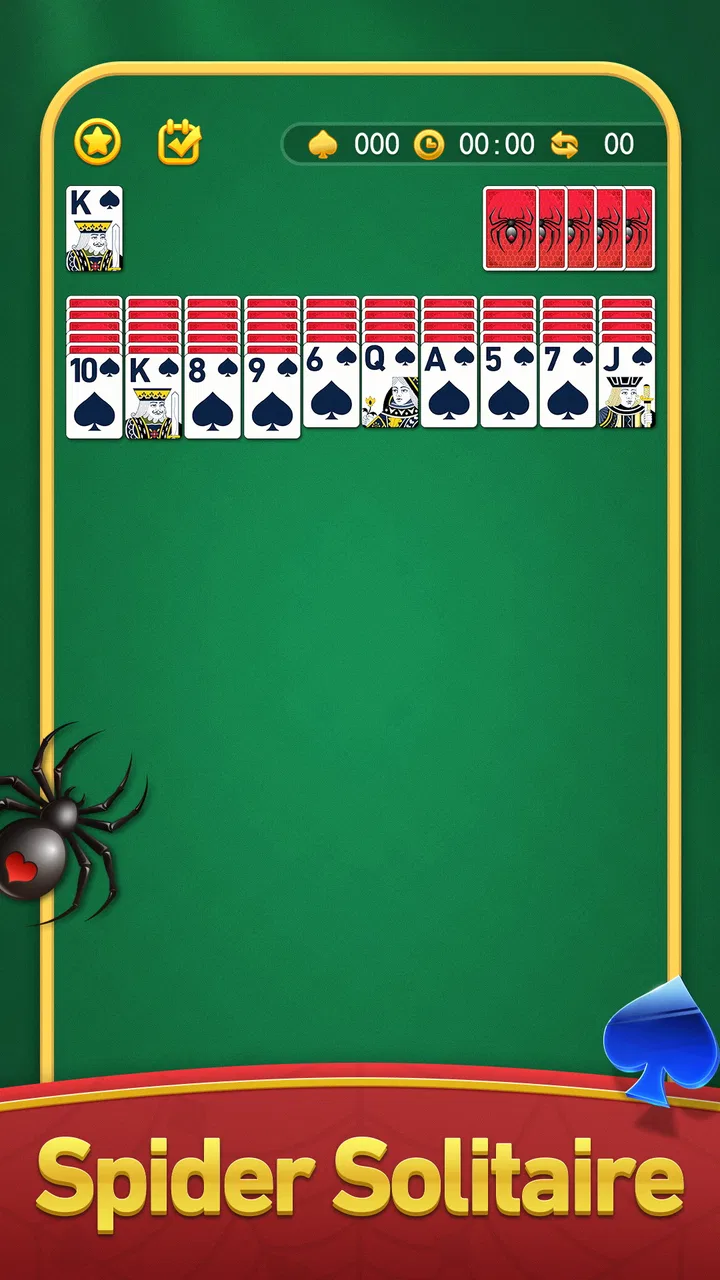
Spider Solitaire Card Game
- 4.7
- Rating
- 1.00M
- Installs
- Free
- Price

 Analysis by App-foxy
I spent time with Spider Solitaire Card Game as the kind of quiet board game I can open when I want something familiar rather than something demanding. It is a free card game from Degoo ltd, built around Spider Solitaire and aimed at Everyone. That simple focus is its main appeal: there is no need to learn a large world, remember a story, or coordinate with other players before starting. I can deal a hand, look for a sensible opening, and decide whether I have the patience to finish it.
What makes this version worth considering is not a dramatic reinvention of solitaire. It is the straightforward rhythm. The game belongs to the board category, but it feels more like a personal puzzle than a traditional competitive board experience. I play against the layout, my own choices, and the temptation to move cards too quickly. For a short break, that can be exactly enough.
How the first games establish their goals
The early goal is immediately understandable: arrange the cards into complete sequences while managing the columns carefully. Spider Solitaire looks easy when the cards are neatly visible, but the first few moves already ask me to think ahead. A move that exposes a useful card can be better than one that appears to create a longer sequence. That small tension gives the game more substance than a purely automatic card-matching exercise.
You May Also Like

 Blood Strike: 2.5 Anniversary
Blood Strike’s Loadouts Turn Every Drop Into a Tactical Gamble
A close look at Blood Strike’s custom loadouts: how fast access to signature weapons reshapes its battle royale rhythm, rewards preparation, and narrows the gap between fights.

 Pandora - Music & Podcasts
Pandora’s Music Is Easy to Start, but Harder to Recover
Pandora’s strength is its low-effort path from a seed to a station. Its weak spot is how much confidence it asks you to place in connection, setup, and quiet recovery.

 8 Ball Pool
 Is Built on Rivalries, Rematches, and Routine
A close look at the rivalries, rematches, shared routines, and unanswered safety questions that turn a quick pool match into a persistent mobile community.

 Samsung Music
’s Quiet Strength Is Playing What You Already Own
Its reach comes less from spectacle than from dependable access to a personal library. That simplicity is both the app’s strongest retention engine and its ceiling.

 AccuWeather: Weather Radar
AccuWeather Review: A Quick, Clear Forecast for Everyday Decisions
For everyday plans, the best forecast is the one you can understand quickly. AccuWeather makes rain timing, radar, and local conditions easy to act on, with a few trade-offs.

 Hill Climb Racing
Why Hill Climb Racing Still Turns Crashes Into One More Run
A tiny car, a bumpy hill and one more upgrade: Hill Climb Racing keeps resurfacing because its simple chaos makes every near-miss feel personal.
More From Our News Desk



I like that the basic objective does not need a long explanation. Someone who has played card games on a phone can begin almost at once, while a newcomer can learn by experimenting. The interface is centered on the cards, so the game does not bury the main action under a complicated collection of menus. That makes it suitable for a quick first session, especially when I do not want to spend several minutes configuring a new game.
There is also a useful difference between playing to finish and playing to improve my decisions. At first, I focus on finding any legal move. After a few hands, I start asking better questions: should I clear a column now, preserve an empty space for later, or delay a tempting sequence because it may block another suit? Those questions create early personal goals even when the game itself remains deliberately simple.
A realistic use case is a short wait at a station or a quiet moment before bed. I can play without needing sound, a connection with another person, or a large time commitment. If I have only a few minutes, I can still make meaningful progress through the layout. If I have longer, I can stay with a difficult hand and treat it as a small concentration exercise.
Why the opening moves matter more than they seem
The strongest early habit is to avoid treating every available move as equally good. I found it helpful to look first for moves that reveal a hidden card or create room, then consider whether a sequence can be rebuilt afterward. This is not a flashy feature, but it changes the feel of the game. The layout becomes something I read and plan rather than something I simply clear from left to right.
Another practical tip is to pause before filling an empty column. An open space is valuable because it can temporarily hold a long movable sequence. Using it immediately may make the board look tidier while reducing future options. That trade-off is where the game begins to reward patience, and it is one reason the experience can remain interesting after the novelty of the first hand has gone.
Progress signals and the feeling of moving forward
Spider Solitaire does not need a large progression system to give a session shape. The clearest progress signal is the board itself. A column that has been opened, a sequence that has been organized, or a difficult blockage that has finally been resolved all provide immediate feedback. I can see whether my position is improving, even before the hand reaches its conclusion.
That visual feedback works particularly well for players who prefer small, understandable goals. Instead of chasing a complicated upgrade path, I can set a target for the current hand: expose more cards, preserve flexibility, or complete a sequence without undoing a useful arrangement. The satisfaction comes from making the layout more manageable through deliberate choices.
The game has reached over a million installs and holds a 4.7 average from around 9.9 thousand ratings, which suggests that this uncomplicated format has found a substantial audience. I would not treat those figures as proof that every player will enjoy it, but they do fit my impression of the game as an accessible, low-pressure solitaire option rather than an obscure experiment.
Progress here is more personal than social. I am not comparing my board with another player in the same moment, and the motivation comes from solving the hand in front of me. That is a strength for anyone who wants a private puzzle. It is less appealing if I need visible rankings, multiplayer tension, or a constant stream of external rewards to keep playing.
Small decisions that create useful momentum
I found that the best sessions often begin with a modest objective rather than an expectation of a perfect finish. For example, I may concentrate on exposing one blocked card, then reassess the whole board. This prevents the common mistake of committing to a plan that stopped working several moves earlier. In a game with a calm pace, changing direction is part of good play, not a sign that the session has failed.
It also helps to distinguish between progress that looks attractive and progress that improves mobility. Building a long visible run can feel satisfying, but if it locks important cards underneath, it may not be useful. I pay more attention to how many columns remain flexible than to how orderly the board appears. That is a specific Spider Solitaire lesson that becomes clearer with repeated play.
The free price makes experimentation easy. I can install it as a casual option without planning around a purchase, and the Everyone rating makes it broadly suitable for shared household devices. The trade-off is that a free, focused game may feel less substantial to people who expect a large amount of content, deep customization, or a campaign with a strong narrative arc.
Difficulty, pacing, and the point where patience matters
The difficulty curve in a Spider Solitaire game is naturally tied to the quality of the deal and the order of decisions. Some hands feel open enough to encourage a steady rhythm. Others become restrictive because a useful card is buried or because an early move removes too much flexibility. I appreciate that the challenge usually comes from managing the layout rather than from fast reactions. I can think, reconsider, and play at my own speed.
That pacing makes the game approachable for beginners, but it can also expose a limitation. Players who want a clearly staged increase in difficulty may find the experience less structured than a puzzle game with named chapters or carefully signposted levels. The challenge is present, yet it is expressed through the hand and my choices rather than through an obvious ladder of increasingly complex objectives.
The current version is 1.6.32, and the game supports devices running Android 6.0 or later. For someone deciding whether an older Android phone can handle it, that minimum requirement is useful and reassuring. I would still check the device’s available storage and general condition before installing any mobile game, but this is not the sort of title I choose for demanding graphics or high-speed performance.
One of the most important pacing decisions is knowing when to stop forcing a hand. I sometimes reach a position where every move creates another blockage. Continuing can be worthwhile if I am testing a new approach, but it can also turn a relaxing break into repetitive frustration. The game works best when I treat a difficult layout as a puzzle to study, not as an obligation to finish at any cost.
Who will enjoy the challenge and who may not
I would recommend it to someone who likes familiar card rules, quiet concentration, and sessions that can expand or contract around the day. It suits players who enjoy spotting patterns and accepting that a good move may only reveal its value several turns later. It is also a sensible choice for people who want a game that does not demand rapid tapping or constant attention to a story.
I would be more cautious recommending it to someone who needs strong long-term progression. If your favorite mobile games are built around character development, elaborate unlocks, competitive seasons, or a steady stream of new mechanics, this may feel too contained. The appeal depends on whether solving another layout is enough motivation. For me, it is often enough, but not every player will find the same replay value in a focused solitaire loop.
It may also be the wrong choice if you are specifically looking for a traditional Klondike experience rather than Spider Solitaire. The two are related, but they do not create the same planning problems, and familiarity with one does not guarantee that the other will feel natural immediately. I would choose this game for Spider’s layered sequences and column management, not because it represents every form of solitaire.
Retention without turning every session into pressure
The game’s ability to keep me playing comes mainly from the desire to resolve an unfinished layout and improve the next set of decisions. That is a gentler form of retention than a system built around constant notifications or a complicated reward track. I can leave after one hand and return later without feeling that I have missed a major event. For a casual card game, that restraint is valuable.
At the same time, the same simplicity can limit its pull. There is no need to invent a grand reason to keep playing: each hand is the reason. If the basic act of sorting sequences does not hold your attention, the game may not offer enough variety to change your mind. I see that as an honest trade-off rather than a flaw that can be solved by adding more decoration.
My most useful routine is to use the game in two different modes. During a short break, I play quickly but still reserve a moment to inspect the board before making a major move. During a longer session, I deliberately slow down and treat each empty column as a resource. Separating those modes keeps the game from feeling either too rushed or unnecessarily serious.
Another helpful approach is to avoid judging a hand only by whether it ends in success. A failed attempt can show me that I spent an empty column too early, built a sequence without considering the cards underneath, or ignored a revealing move. That reflection gives the next session a purpose. It is a small but meaningful way to create progression when the game’s structure is intentionally minimal.
The 731 written reviews associated with the game add context to its broad reception, but my recommendation remains conditional. A popular, highly rated casual game can still be a poor fit for someone who wants multiplayer competition or a deep content pipeline. I would choose it for dependable solo card play, not as a replacement for a more expansive board-game collection.
How it compares with familiar alternatives
Compared with a physical deck, this version is more convenient because the setup is immediate and the layout stays readable on a phone. I do not need a table, spare space, or time to shuffle. The physical alternative still wins if you enjoy handling cards, teaching a group, or making the session feel like a shared activity. This app is firmly a solo convenience rather than a social tabletop substitute.
Compared with a broader solitaire collection, its focused identity can be both an advantage and a weakness. A collection gives me more rulesets when one format becomes repetitive, while this game keeps attention on Spider Solitaire and its particular planning demands. I prefer the focused approach when I already know what kind of card puzzle I want. I would choose a multi-game app when variety matters more than depth within one format.
Compared with a competitive board game, it is calmer and easier to fit into an unpredictable schedule. There is no opponent waiting for my turn, so I can stop at a natural point. The cost of that calm is the absence of surprise from another person’s strategy. If your enjoyment comes from bluffing, negotiation, or reacting to an opponent, a solo solitaire game will feel limited no matter how polished the card layout is.
My verdict on the progression and everyday value
After using it as both a quick distraction and a slower puzzle, I see Spider Solitaire Card Game as a clean choice for players who want the core Spider experience without a heavy layer of systems around it. The early goals are clear, the board provides readable progress, and the difficulty comes from planning rather than reflexes. Its pacing is especially comfortable when I want something I can pause without losing the mood of the evening.
The progression verdict is therefore positive but specific: the game sustains play through increasingly thoughtful decisions, not through a large unlock structure. That is enough for me when I am in the right mood. I enjoy trying to preserve options, opening columns at the right moment, and learning from a layout that went wrong. Those details give the familiar rules a surprising amount of replay value.
There are limits. Players seeking a rich campaign, strong social features, or a visibly expanding set of goals should look toward a larger board-game app. Even fans of solitaire may prefer an alternative that bundles several variants when they want to switch formats. This title is at its best when you specifically want Spider Solitaire and appreciate a quiet, direct interface over a crowded feature list.
For Android users on version 6.0 or later, the free entry point makes it easy to try without much commitment. The Everyone rating also makes it a reasonable family-friendly option, although individual preferences about screen time and puzzle difficulty still matter. I would install it for a commute, a waiting room, or a calm end-of-day routine, especially when I want a game that asks for attention without demanding all of it.
My final impression is that Degoo ltd has kept the focus where it belongs: on the decisions inside each Spider layout. It does not need to pretend to be a full board-game platform. If you want a relaxed solo card puzzle with enough strategic friction to reward patience, this is a worthwhile free download. If you need constant novelty or competitive energy, its focused design will probably feel narrow rather than satisfying.
FAQs for Spider Solitaire Card Game
01What is Spider Solitaire Card Game, and how is it played?
Spider Solitaire Card Game is a classic single-player card game in which you arrange cards into complete sequences from King down to Ace, usually within the same suit. Once a full sequence is created, it is removed from the table. The goal is to clear all cards using careful planning, strategic moves, and the option to deal additional cards when no useful moves remain.
02Can I play Spider Solitaire Card Game offline?
Yes, Spider Solitaire Card Game is generally designed to be playable without an internet connection, making it suitable for travel, commuting, or relaxing in places with limited coverage. Offline access may include the main solitaire modes and basic statistics, although advertisements, cloud synchronization, online leaderboards, daily challenges, or certain special features may require an active internet connection.
03Does Spider Solitaire Card Game offer different difficulty levels and game modes?
Most versions provide several difficulty options based on the number of suits used. One-suit games are easier and are useful for beginners, while two-suit and four-suit layouts require much more planning and are better suited to experienced players. Some editions may also include daily challenges, timed games, customizable deals, hints, undo options, and multiple scoring systems.
04Is Spider Solitaire Card Game free to download and play?
Spider Solitaire Card Game is commonly available as a free download, allowing users to start playing without purchasing the application. However, the free version may be supported by advertisements, including banners or occasional full-screen promotions. Depending on the edition, optional purchases may remove ads, unlock additional themes, provide extra statistics, or activate premium features without changing the basic card-game experience.
05Does Spider Solitaire Card Game collect personal information or require special permissions?
The permissions and data practices can vary depending on the developer and whether you use the Android or iOS version. The game may request access related to advertising, analytics, notifications, or online services, but it should not need access to sensitive features such as your contacts or microphone for normal gameplay. Before installing, review the store listing and privacy policy for the latest details.
Pros
- Simple rules make it easy for beginners to start playing.
- Multiple difficulty levels provide a challenge for experienced players.
- Offline play lets you enjoy games without an internet connection.
- Undo and hint options help when you get stuck.
- Short rounds are convenient for quick breaks.
Cons
- Some deals may feel repetitive after extended play.
- Hints and undo features can reduce the challenge for purists.
- Ads may interrupt gameplay
- depending on the version.
- Advanced difficulty can be frustrating for casual players.
- Limited social features offer little interaction with other players.

Spider Solitaire Card Game
Gallery